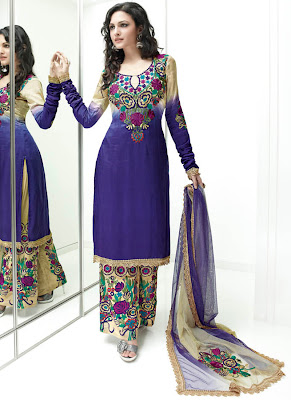
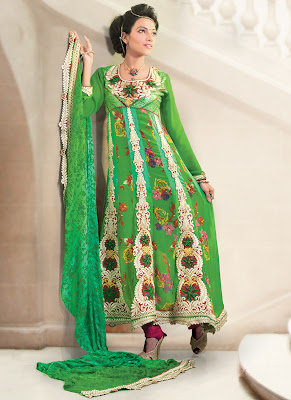
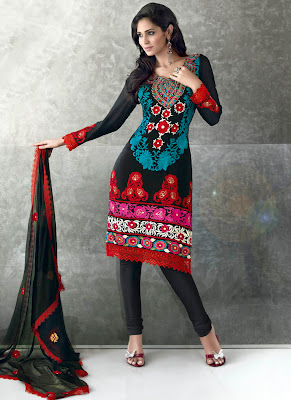
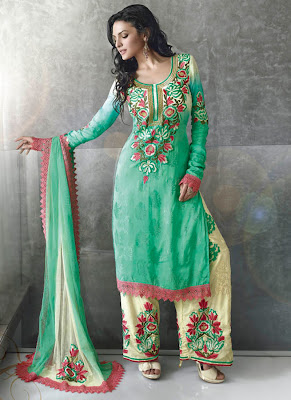
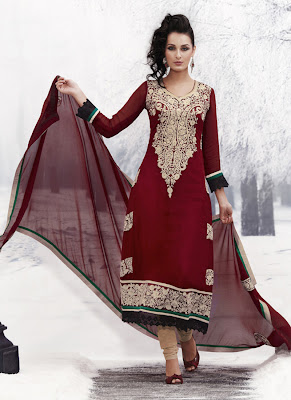
Pakistani Suits Definition
Source(Google.com.pk)
Clothing in India varies from region to region
depending on the ethnicity, geography, climate and cultural traditions
of the people of that region. Historically, men and women's clothing has
evolved from simple Langotas and loincloths to cover the body to
elaborate costumes not only used in daily wear but also on festive
occasions as well as rituals and dance performances. In urban areas,
western clothing is common and uniformly worn by people of all strata.
India also has a great diversity in terms of weaves, fibres, colours and
material of clothing. Color codes are followed in clothing based on the
religion and ritual concerned. For instance, Hindus lady's wear white
clothes to indicate mourning while Parsis and Christians wear white to
wedding.The Didarganj Yakshi depicting the dhoti wrap
India's
recorded history of clothing goes back to the 5th millennium CB in the
Indus Valley Civilisation where cotton was spun, woven and dyed. Bone
needles and wooden spindles have been unearthed in excavations at the
site.The cotton industry in ancient India was well developed, and
several of the methods survive until today. Herodotus, an ancient Greek
historian described Indian cotton as "a wool exceeding in beauty and
goodness that of sheep". Indian cotton clothing was well adapted to the
dry, hot summers of the subcontinent. Most of the present knowledge of
ancient Indian clothing comes from rock sculptures and paintings in cave
monuments such as Ellora. These images show dancers and goddesses
wearing what appears to be a dhoti wrap, a predecessor to the modern
sari.The upper castes dressed themselves in fine muslin and wore gold
ornaments[ The Indus civilisation also knew the process of silk
production. Recent analysis of Harappan silk fibres in beads have shown
that silk was made by the process of reeling, a process known only to
China until the early centuries AD.According to the Greek historian
Arrian:
The Buddha, in Greco-Buddhist style, 1st–2nd century CE, Gandhara(Modern eastern Afghanistan).
"The
Indians use linen clothing, as says Nearchus, made from the flax taken
from the trees, about which I have already spoken. And this flax is
either whiter in colour than any other flax, or the people being black
make the flax appear whiter. They have a linen frock reaching down
halfway between the knee and the ankle, and a garment which is partly
thrown round the shoulders and partly rolled round the head. The Indians
who are very well-off wear earrings of ivory; for they do not all wear
them. Nearchus says that the Indians dye their beards various colours;
some that they may appear white as the whitest, others dark blue; others
have them red, others purple, and others green. Those who are of any
rank have umbrellas held over them in the summer. They wear shoes of
white leather, elaborately worked, and the soles of their shoes are
many-coloured and raised high, in order that they may appear taller."
Evidence
from the 1st century AD shows some cultural exchanges with the Greeks.
Indo-Greek influence is seen in the Greco-Buddhist art of the time. The
Buddhas were portrayed as wearing the Greek himation, which is the
forerunner of the modern sa?ghati that forms a part of the Kasaya of
Buddhist monks.During the Maurya and Gupta period, the people continued
to wear the three piece unstitched clothing as in Vedic times. The main
items of clothing were the Antariya made of white cotton or muslin, tied
to the waist by a sash called Kayabandh and a scarf called the Uttariya
used to drape the top half of the body.
New trade routes, both
overland and overseas, created a cultural exchange with Central Asia and
Europe. Romans bought indigo for dyeing and cotton cloth as articles of
clothing. Trade with China via the Silk road introduced silk textiles
into India. The Chinese had a monopoly in the silk trade and kept its
production process a trade secret. However, this monopoly ended when,
according to legend, a Chinese princess smuggled mulberry seeds and
silkworms in her headdress when she was sent to marry the king of Khotan
(present day Xinjiang). From there, the production of silk spread
throughout Asia, and by AD 140, the practise had been established in
India. Chanakya's treatise on public administration, the Arthashastra
written around 3rd century BC, briefly describes the norms followed in
silk weaving.Asia Fashion Exchange (AFX) is an annual event held in
Singapore. It was launched in 2010 as part of a joint effort by
International Enterprise (IE) Singapore, SPRING Singapore (SPRING), and
the Singapore Tourism Board (STB) to develop the long-term
sustainability of Singapore’s fashion industry. It targets to build
capability, provide an international platform for showcasing Asian
talent and to position Singapore as a gateway to Asian designers and
markets.Asia Fashion Exchange consists of events for both trade
professionals as well as consumers. The four key events are Blueprint, a
trade show that positions itself as the fashion trade gateway to Asia
which creates business opportunities between international buyers and
promising design players ; Asia Fashion Summit, a premier business
conference that generates thought leadership content and insights on
fashion topics for industry professionals; Audi Fashion Festival
Singapore, a showcase of world-class collections by top and emerging
designers and labels, both international and Asian; and Audi Star
Creation, a regional fashion design competition to spot budding
talent.Asia Fashion Exchange 2011 took place from 11 to 22 May 2011.The
Audi Fashion Festival's (AFF) 2011 run was from 13 to 19 May 2011 at the
Tent@Orchard. The tents are set up at the Ngee Ann City Civic Plaza for
the duration of AFF. The AFF opening show was Missoni, with Angela
Missoni, Vittorino Missoni and Margherita Missoni in attendance. The
closing show was Emanuel Ungaro, with creative director Giles Deacon in
attendance. Other shows included Antonio Berardi, Erdem, alldressedup,
PARCO next NEXT, Swarovski together with Prabal Gurung, Greyhound, RAOUL
and the LASALLE College of the Arts Graduate Fashion Show.The second
edition of BLUEPRINT showcased more than 120 international and Asian
brands. The trade show was visited by more than 250 buyers from a wide
cross-section of international stores, such as Le Mill in Mumbai, Triple
Major in Beijing, and Oki-ni the United Kingdom.The winners of Star
Creation 2011 were selected from 144 entries from all over the region.
Chen Zhi Gang from China, Tiang Boon Tieon from Malaysia and Tsai Ming
Hung from Singapore are the selected winners from 12 finalists and
Hiroyuki Watanabe from Japan won the Audi Young Designer Award.
Pakistani Suits
 |
| Pakistani Suits |
 |
| Pakistani Suits |
 |
| Pakistani Suits |
 |
| Pakistani Suits |
 |
| Pakistani Suits |
 |
| Pakistani Suits |
 |
| Pakistani Suits |
 |
| Pakistani Suits |
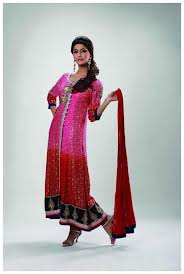 |
| Pakistani Suits |
 |
| Pakistani Suits |
Pakistani Suits Definition
Source(Google.com.pk)
Like any other women all over the world, Pakistani women too are very
conscious about their fashion. Pakistan has given way to lots of
globally acclaimed fashion designers that contributes to the
international fashion market by designing breathtakingly beautiful
Pakistani clothes. Ethnic dresses are very popular these days and salwar
kameez is their national dress, and still remains to be in top in the
fashion world. However, we can see change is reflected upon their
fashion too with change in times. Now the variations and modifications
in traditional Pakistani clothes are very popular.
Pakistani women also wear western clothes but still anarkali suits,
Pakistani traditional suits, etc are going strong. The parallel pants
salwar is also very famous and is making its mark on the fashion
industry.
These suits are embellished with heavy embroidery and work such as
resham stones and mirrors, moti work, zari work and many other forms of
work. Pakistani clothes are often studded and quite fashionable. They
are exquisite and rich and are appropriate for party wear. The
traditional dress continues to see several changes in itself with a lot
of experimentation going on, and all are very successful and popular.
Pakistani women are very fond of the sharara style dresses and are worn
especially during festivals like Eid-ul-Fitr. Saris and lehengas are
also worn by Pakistani women and it is a fashion symbol of the country.
It can be aptly said that the fashion of Pakistan along with being
traditional is very gorgeous and vivid, awesome and mesmerizing. The
geometric patterns which are related with their religion are often
reflected on their fashion clothing too, filled with exquisite
embroidery.
In clothing, a suit is a set of garments made from the same cloth,
usually consisting of at least a jacket and trousers. Lounge suits are
the most common style of Western suit, originating in the United Kingdom
as country wear.[1] Other types of suit still worn today are the dinner
suit, part of black tie, which arose as a lounging alternative to dress
coats in much the same way as the day lounge suit came to replace frock
coats and morning coats; and, rarely worn today, the morning suit. This
article discusses the lounge suit (including business suits), elements
of informal dress code.
In regional clothing, Balochi people wear shalwar kameez of thick cloth
with very wide shalwar to prevent themselves from the hot wind of dry
Sulaiman Range and Kharan Desert. They wear Balochi turban made of a
very long cloth, often in white color to prevent their head from sun
rays.Sindhi people wear shalwar kameez with traditional Sindhi cap and
Ajrak of beautiful designs which are made locally.Punjabi men wear
simple shalwar kameez, Kurta Shalwar and Dhoti kurta according to
Punjabi climate. Turban of a thin cloth is also used with Shalwar Kameez
especially in rural areas of Punjab where it is called Pagri. Khussa is
also used with Dhoti Kurta. In Pashtun dress, people wear traditional
Peshawari Chappal in feet and Pakul with Shalwar kameez. Kashmiri people
use Pheran Shahmina, Shahtoosh and Jamavar which makes them warm in the
cold climate of Kashmir.
Salwar kameez has been worn by women for hundreds of years now. It was
the traditional outfit worn by the women of Punjab and Sindh region but
now it is worn by women all across the country and it has taken the
fashion industry by storm. With different and new patterns coming up
everyday this outfit has evolved a lot with time. It is an ensemble of
three types of clothing, the salwar or the pant, the kameez or the tunic
and a dupatta that can be worn as a scarf to enhance the entire look.
There are different patterns available in this outfit and anarkali
salwar kameez is one of them. It is something that has a very
traditional essence to it. The salwar in anarkali is tight fitting so is
the upper portion of the kameez; the lower portion has a more frock
like appearance. It generally has a full sleeve but you can get half
sleeve ones too. As for the material used it can be made out of simple
material like cotton as well as silk and georgette.
When it comes to designs it can act like a canvas for the designers, as
one can experiment with different types of designs including zardosi
which gives this outfit a glamorous touch. The ones made with silk and
georgette is generally worn during special occasions but the ones made
with cotton and simple chiffon can be worn on a regular basis.
You can get them at any clothing store that sells women’s clothing.
However, if you want something exclusive and one of a kind then you can
check out the boutiques owned by designers. these designers can also
make customized pieces for you. You can also check out the online stores
that sell beautifully designed salwar kameez. They have products that
will suit every style and taste. You can check out their online
catalogue and select the ones you like. You can make the payment online;
however some websites also gives you the option of cash on delivery. If
the product turns out to be damaged they will replace it for you.
Pakistani Suits
Pakistani Suits
Pakistani Suits
Pakistani Suits
Pakistani Suits
Pakistani Suits
Pakistani Suits
Pakistani Suits
Pakistani Suits
Pakistani Suits
Pakistani Suits